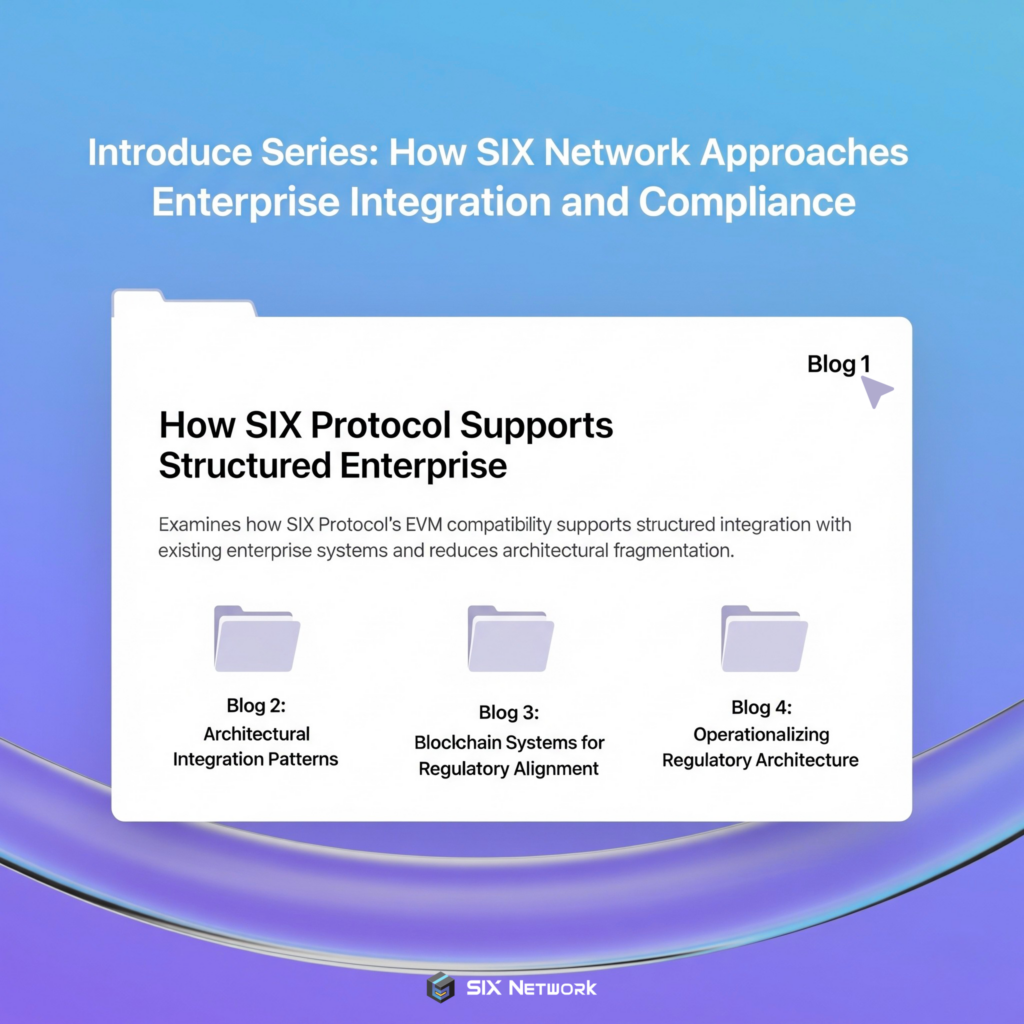
Enterprise blockchain adoption often slows down not because of the technology itself, but because of integration complexity and regulatory considerations. This four-part blog series explores how SIX Network approaches these challenges from an architectural perspective.
Blog 1 examines how SIX Protocol’s EVM compatibility supports structured integration with existing enterprise systems and reduces architectural fragmentation.
Blog 2 explores practical integration patterns, such as adapter layers and event-driven models, that help organizations incorporate blockchain without tightly coupling core systems.
Blog 3 focuses on regulatory alignment, discussing how permission models, traceability, and system design can support compliance-oriented architecture.
Blog 4 looks at operationalization, covering governance, monitoring, and how compliance principles translate into production environments.
Throughout this series, we focus on architectural alignment, governance clarity, and standards-based design as foundations for sustainable enterprise blockchain adoption.
Blog 1
Overcoming Integration Complexity
Part 1: How SIX Protocol Supports Structured Enterprise Blockchain Integration
Enterprise blockchain integration is often perceived as complex and high-risk. In practice, the challenge rarely lies in blockchain technology alone. Instead, complexity arises from how blockchain systems interact with existing enterprise infrastructure, ERP platforms, CRM systems, identity frameworks, data governance models, and regulatory controls.
Many organizations successfully build proof-of-concept projects, but transitioning from pilot to production introduces architectural, operational, and compliance considerations that require structured planning.
SIX Protocol v4.0 was developed with these realities in mind. Rather than introducing a proprietary execution model, SIX Protocol aligns with established industry standards, particularly EVM compatibility. This architectural decision supports integration planning that is more predictable and aligned with existing development ecosystems.
This article is the first in a four-part series exploring how SIX Network approaches integration complexity and regulatory requirements in enterprise environments.
The Practical Role of EVM Compatibility
A common friction point in enterprise adoption is the introduction of new programming languages, tooling stacks, or execution environments. When platforms require proprietary development models, organizations must retrain teams or recruit new talent.
SIX Protocol supports the Ethereum Virtual Machine (EVM) at the core protocol level. Developers can write smart contracts in Solidity and use established development tools such as Hardhat and Truffle. This does not automatically shorten project timelines, but it reduces uncertainty by leveraging a mature ecosystem.
By aligning with widely adopted standards, organizations can reuse existing internal knowledge and external expertise. The decision to support EVM is therefore less about performance marketing and more about minimizing architectural fragmentation.
Supporting Enterprise Workflows Through the SIX Ecosystem
Beyond the protocol layer, SIX Network provides tools that support digital asset implementation.
SIX Garage offers capabilities for issuing and managing digital assets, including token configuration, permission management, and administrative oversight. These functions are designed to assist organizations that require structured governance over digital asset lifecycles.
Pas.ss provides a framework for managing digital privileges and engagement use cases. It integrates with non-custodial wallet models, allowing organizations to implement user-facing digital programs without requiring centralized custody structures.
These tools are not substitutes for enterprise system design. Rather, they serve as building blocks that organizations can integrate into broader digital strategies.
Integration as an Architectural Exercise
Effective enterprise blockchain integration requires separation of concerns. Business logic should remain independent from blockchain execution logic wherever possible. Middleware layers or API gateways can mediate communication between core enterprise systems and blockchain components.
SIX Protocol’s standards-based architecture allows such layering without requiring proprietary infrastructure dependencies. This enables organizations to define clear boundaries between existing systems and blockchain components.
Integration planning should typically include:
• Data flow analysis
• Identity and access control mapping
• Transaction approval workflows
• Monitoring and operational oversight
• Pre-production validation
SIX Network’s design approach supports these structured planning processes rather than replacing them.
Summary
Enterprise blockchain adoption becomes manageable when architectural alignment, governance considerations, and ecosystem compatibility are addressed early.
SIX Protocol’s EVM compatibility and the broader SIX ecosystem are designed to support structured integration planning rather than shortcut it. By relying on established standards and modular tooling, organizations can reduce integration uncertainty and build toward sustainable deployment models.
In the next article, we will examine practical integration patterns that can be applied within enterprise environments using SIX Network infrastructure.
────────────────────────────────────
Learn more about SIX Network
Website l Telegram l Twitter l Facebook l Discord l Medium