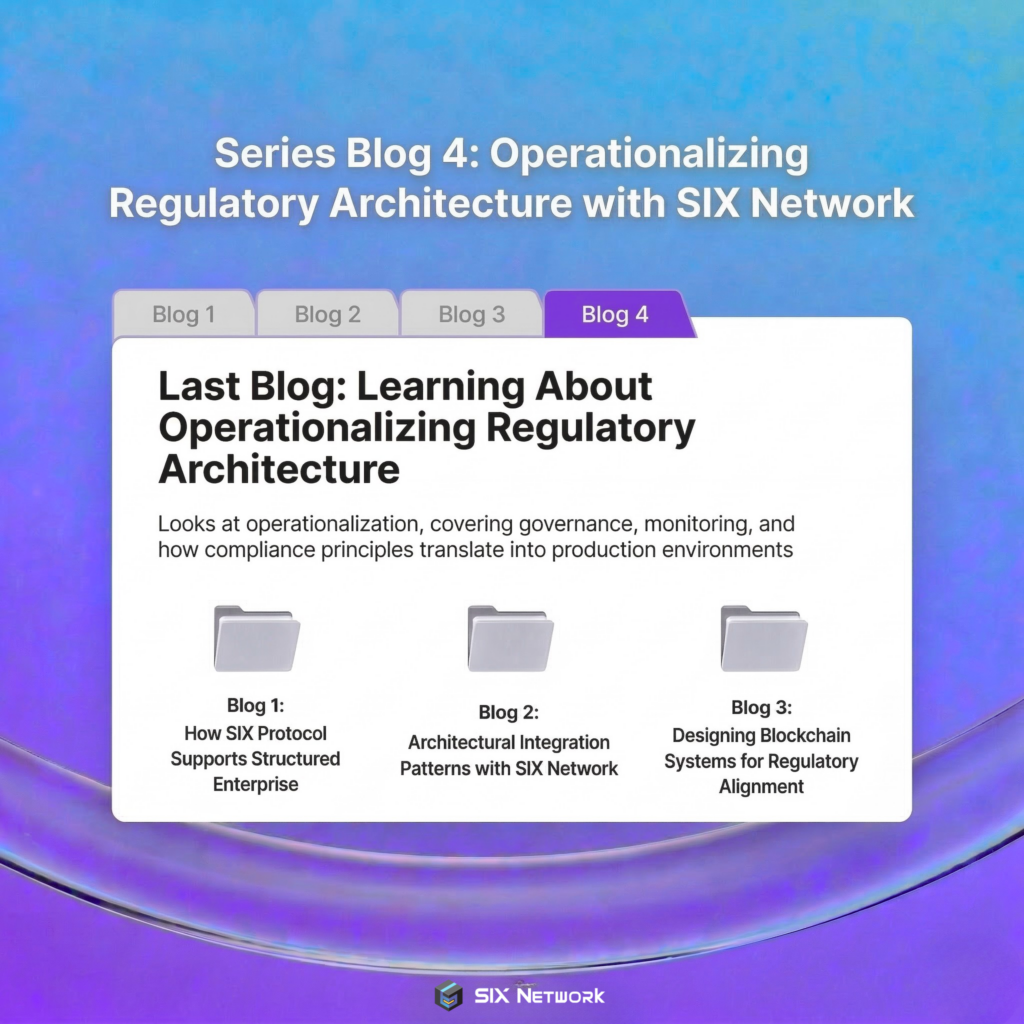
Understanding regulatory principles is only the first step. The more difficult challenge lies in operationalizing those principles within live systems.
Moving from compliance design to production deployment requires coordination between architecture, legal, operations, and security teams.
Embedding Compliance into Operational Workflows
Rather than treating compliance as a reporting function, mature architectures embed regulatory controls into transaction workflows.
Examples include:
• Multi-level approval processes before transaction finalization
• Automated logging of authorization events
• Clearly defined retention and archival policies
• Defined escalation paths for exceptional cases
These controls are implemented primarily in enterprise application logic and governance frameworks. Blockchain serves as a verifiable execution and recording layer.
SIX Garage and related tooling can assist in structuring asset management and permission workflows, but they operate within broader governance systems defined by the organization.
Monitoring and Continuous Oversight
Production systems require observability. Compliance does not end at deployment; it requires continuous oversight.
Architectural monitoring typically covers:
• Transaction latency and failure rates
• Role misuse or unauthorized access attempts
• Data consistency across on-chain and off-chain components
• Audit trail completeness
SIX Network infrastructure can be integrated into existing monitoring frameworks, allowing blockchain operations to be managed alongside other enterprise systems.
From Policy to Implementation
Regulatory frameworks such as GDPR, HIPAA, SOX, or AML/KYC define principles. Implementation varies by jurisdiction and organization.
No protocol can automatically guarantee compliance across all contexts. Instead, infrastructure should provide flexibility and traceability that enable organizations to implement their own compliance interpretations.
SIX Network’s approach emphasizes architectural support rather than automated regulatory guarantees.
Conclusion
Enterprise blockchain deployment in regulated environments requires architectural rigor, governance clarity, and operational discipline.
SIX Network’s standards-based protocol and supporting tools are designed to align with these enterprise requirements, not to replace them.
By approaching integration and compliance as architectural challenges rather than marketing features, organizations can move toward sustainable, production-ready blockchain adoption.